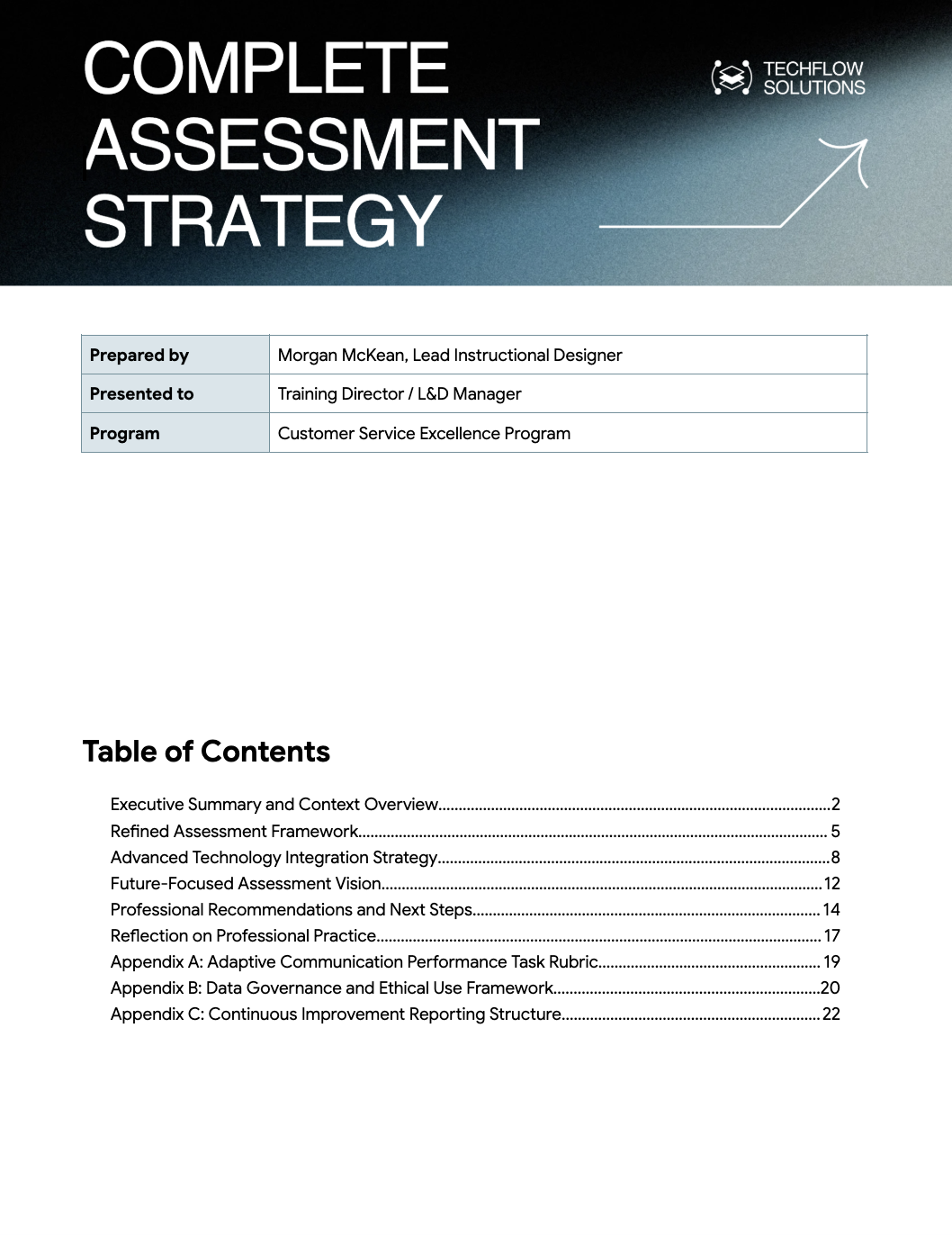
Complete Assessment Strategy for TechFlow
This capstone project, completed as part of an instructional design certificate program, brought together three prior rounds of analysis on TechFlow's failing Customer Service Excellence Program into a single, stakeholder-ready document. The fictional client was running a $150,000/year onboarding program with strong internal metrics and a post-training escalation rate 35% above baseline. The final deliverable was designed to be handed to a Training Director and actually used.

Role
Instructional Designer / Assessment Strategist
Tools, Technologies & Strategies
Cornerstone LMS, Loom, GoReact, Salesforce, Canva, Claude — Complete Assessment System Design, Constructive Alignment, Scenario-Based Assessment, Behaviorally Anchored Rubric Development, AI Ethics in Assessment, Continuous Improvement Framework, Stakeholder Communication, Professional Documentation, Predictive Validity, Scalability Planning, Data Governance, DMADV Framework, PDCA Framework
The Challenge
The problem wasn't that TechFlow's assessments were poorly executed — it was that they were measuring the wrong things entirely. Knowledge checks and scripted role-plays told the organization whether learners could recall policy. They said nothing about whether a representative could handle an angry customer who keeps changing the subject. The challenge was redesigning the assessment architecture from the ground up in a way that a real organization could actually implement, sustain, and improve over time.
My Contribution
I designed the complete assessment strategy end to end, integrating prior analysis into a single professional document. Deliverables included a refined assessment framework, advanced technology integration strategy, a future-focused vision, professional recommendations with full implementation timeline, and a reflection on practice. Three appendices — a behaviorally anchored rubric, a data governance framework, and a continuous improvement reporting structure — were designed to function as working documents, not supporting materials.
Design Decisions
The most important structural decision was treating the three assessment components as functionally non-overlapping: a formative branching simulation system, a summative communication performance task, and a metacognitive reflection protocol. Each one has a distinct job. Remove any of them and there's a genuine gap in what the system covers — not redundancy, not overlap. The second major decision was about what kind of document this needed to be. Academic analysis and professional communication are different genres, and writing for a Training Director required a different editorial standard: what goes in, where it lives, and how much explanation is enough. That shift shaped everything from the executive summary to the appendix formatting.
My thinking, visualized
-
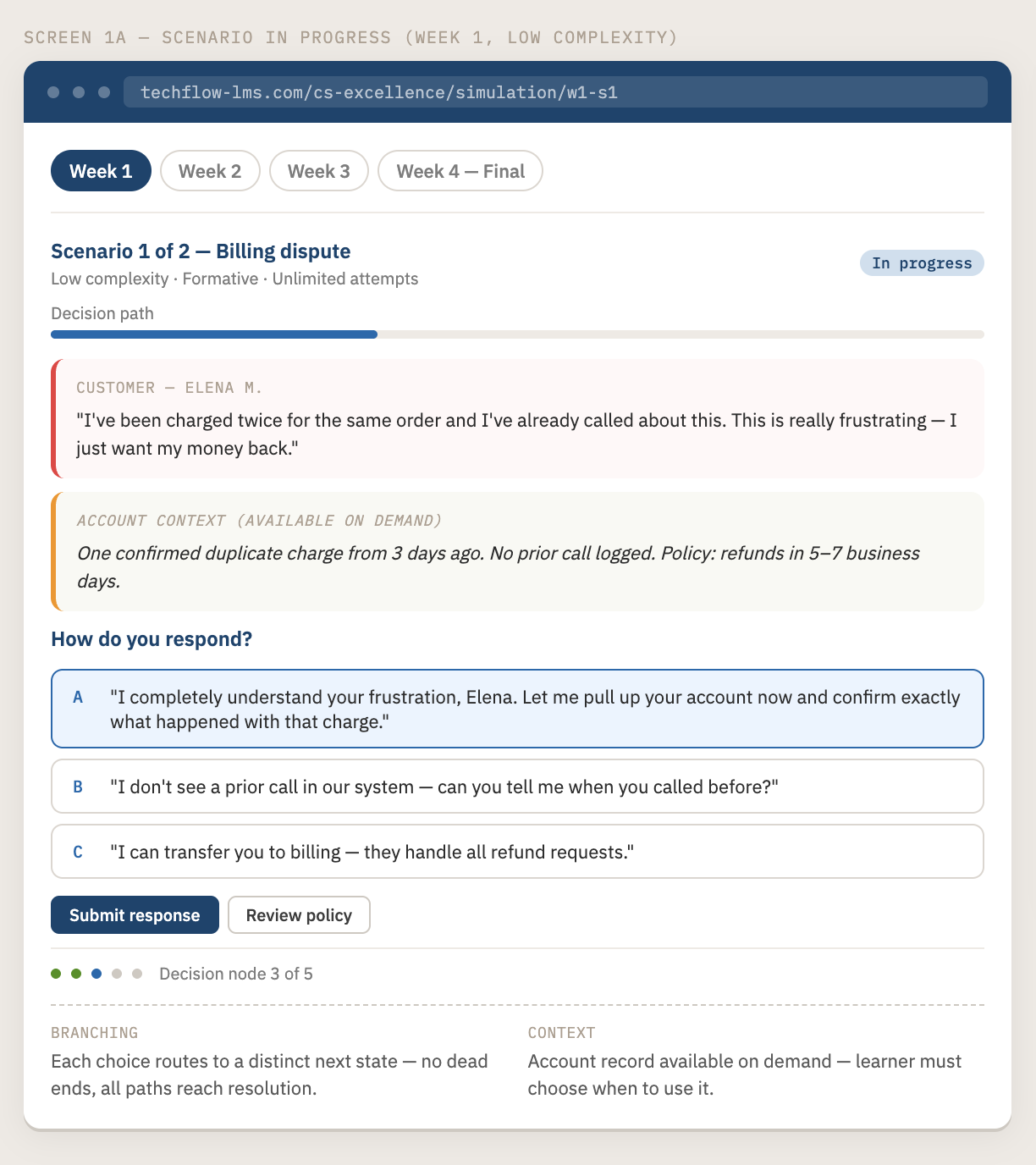
![UI wireframe showing a branching scenario in progress within the TechFlow LMS assessment]()
Scenario in progress
-
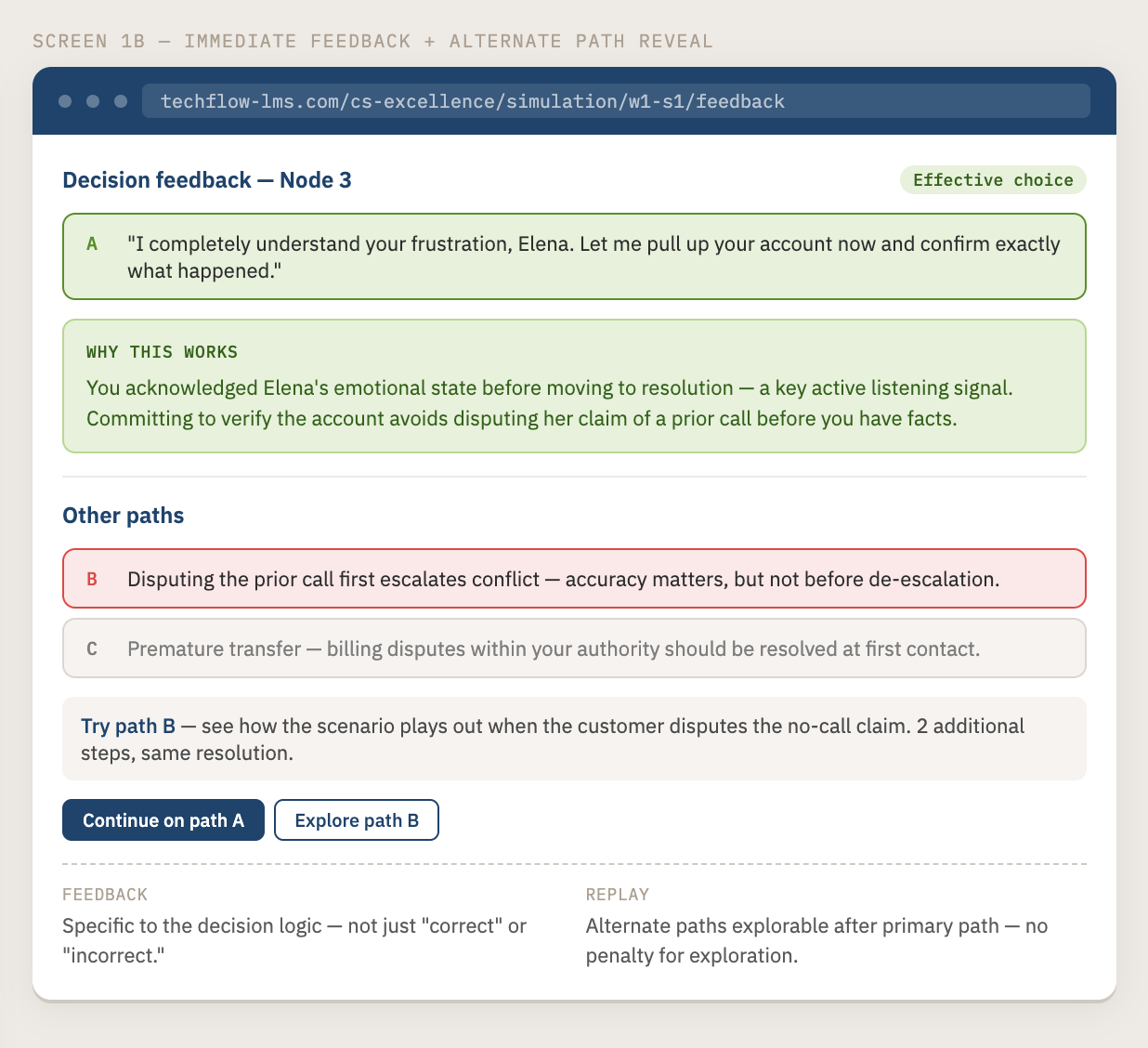
![UI wireframe showing immediate feedback and an alternate path reveal after a scenario response]()
Immediate feedback + alternate path reveal
-
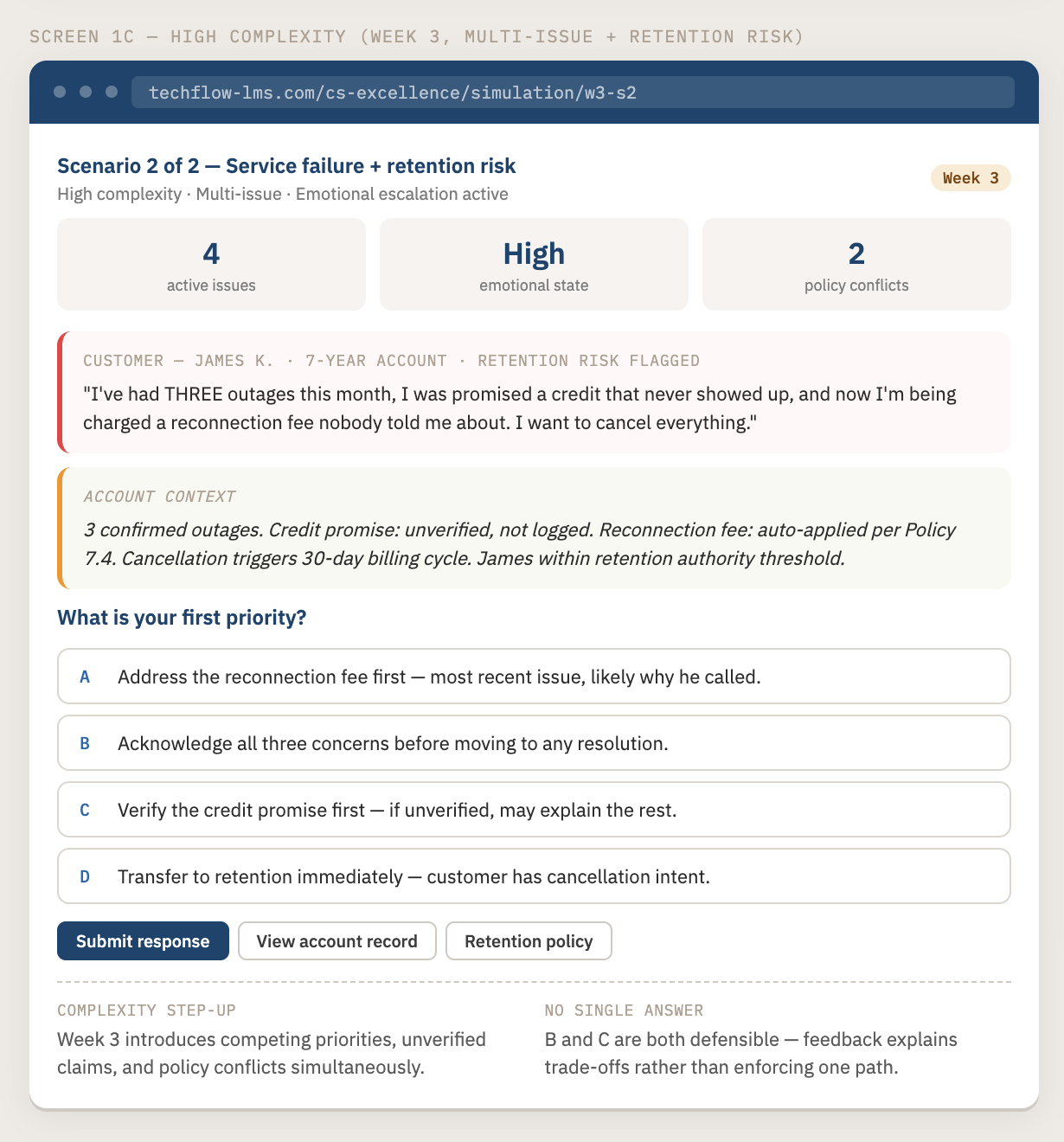
![UI wireframe showing a high-complexity branching scenario screen]()
High complexity branching scenario
-
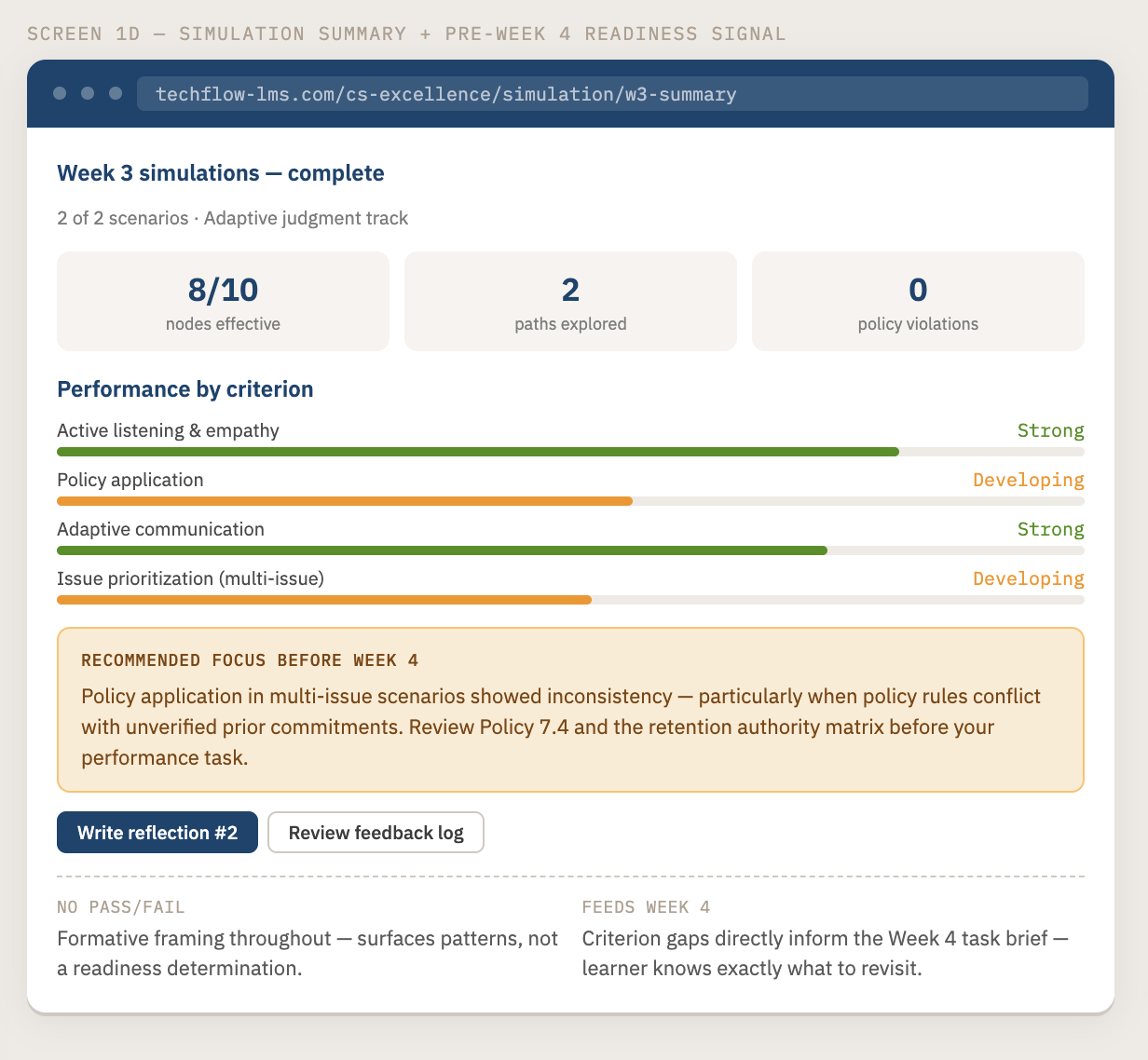
![UI wireframe showing a simulation summary screen with a pre-Week 4 readiness signal]()
Simulation summary + pre-Week 4 readiness signal
-
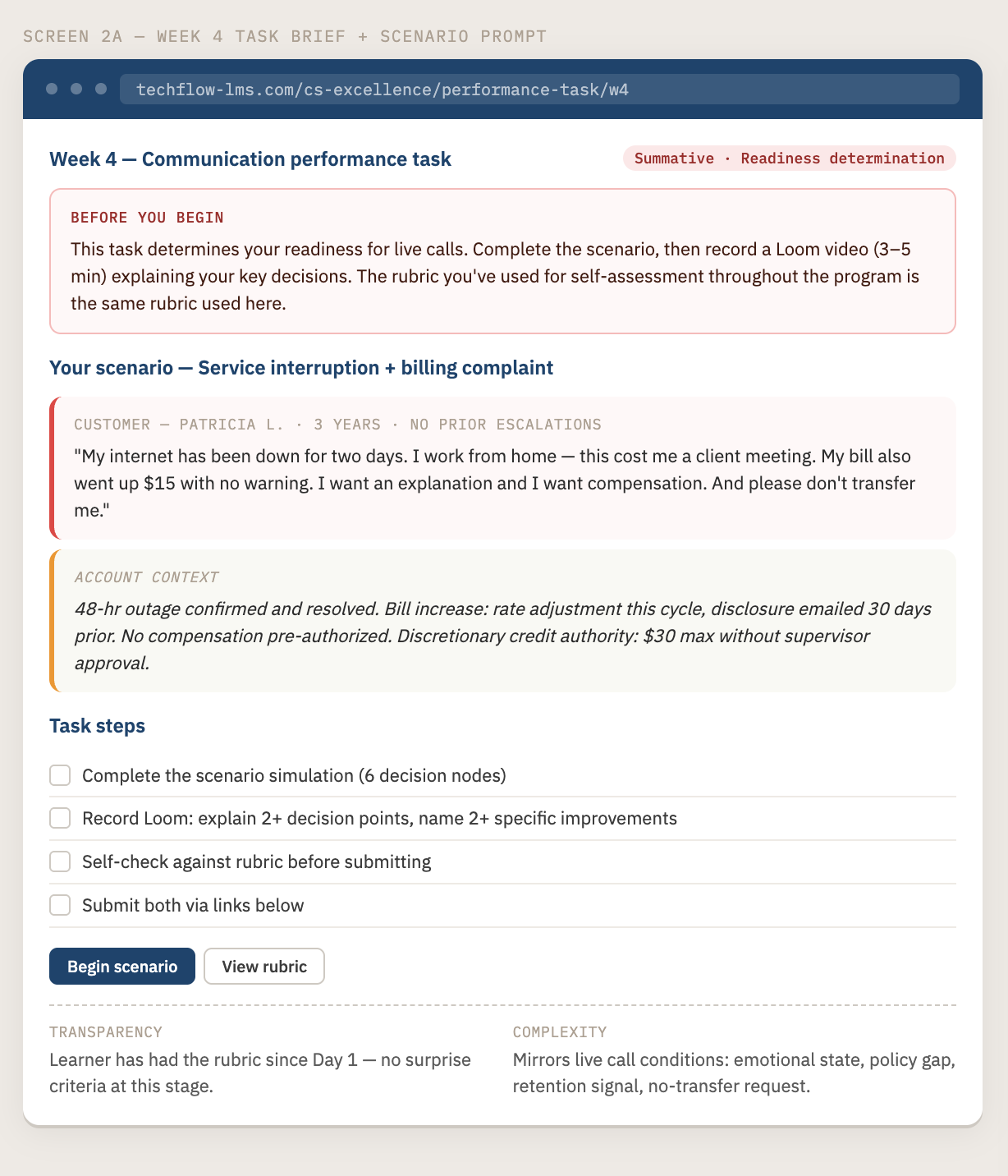
![UI wireframe showing the Week 4 task brief and scenario prompt for the Loom video performance task]()
Week 4 task brief + scenario prompt
-
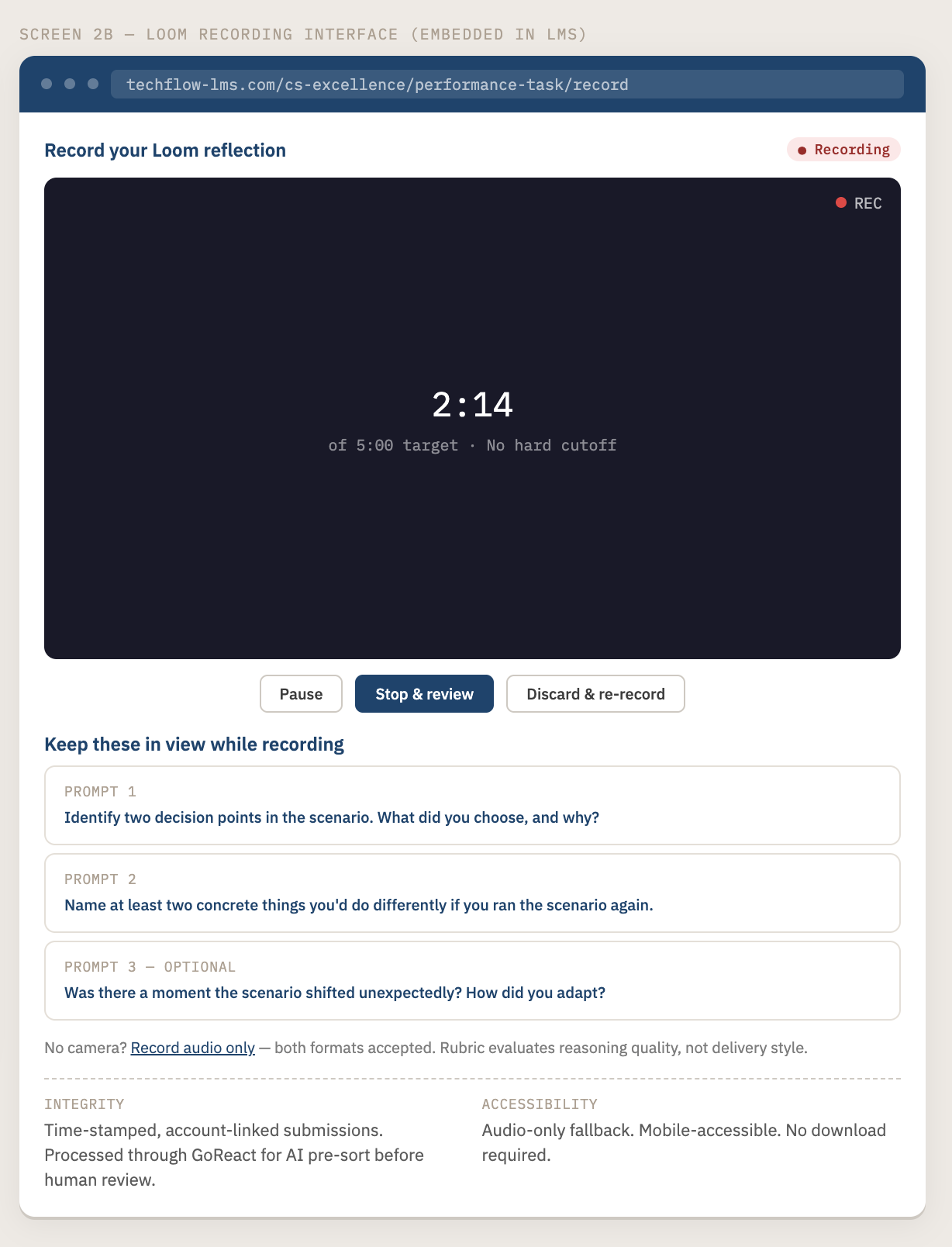
![UI wireframe showing the Loom recording interface embedded within the LMS]()
Loom recording interface (embedded in LMS)
-
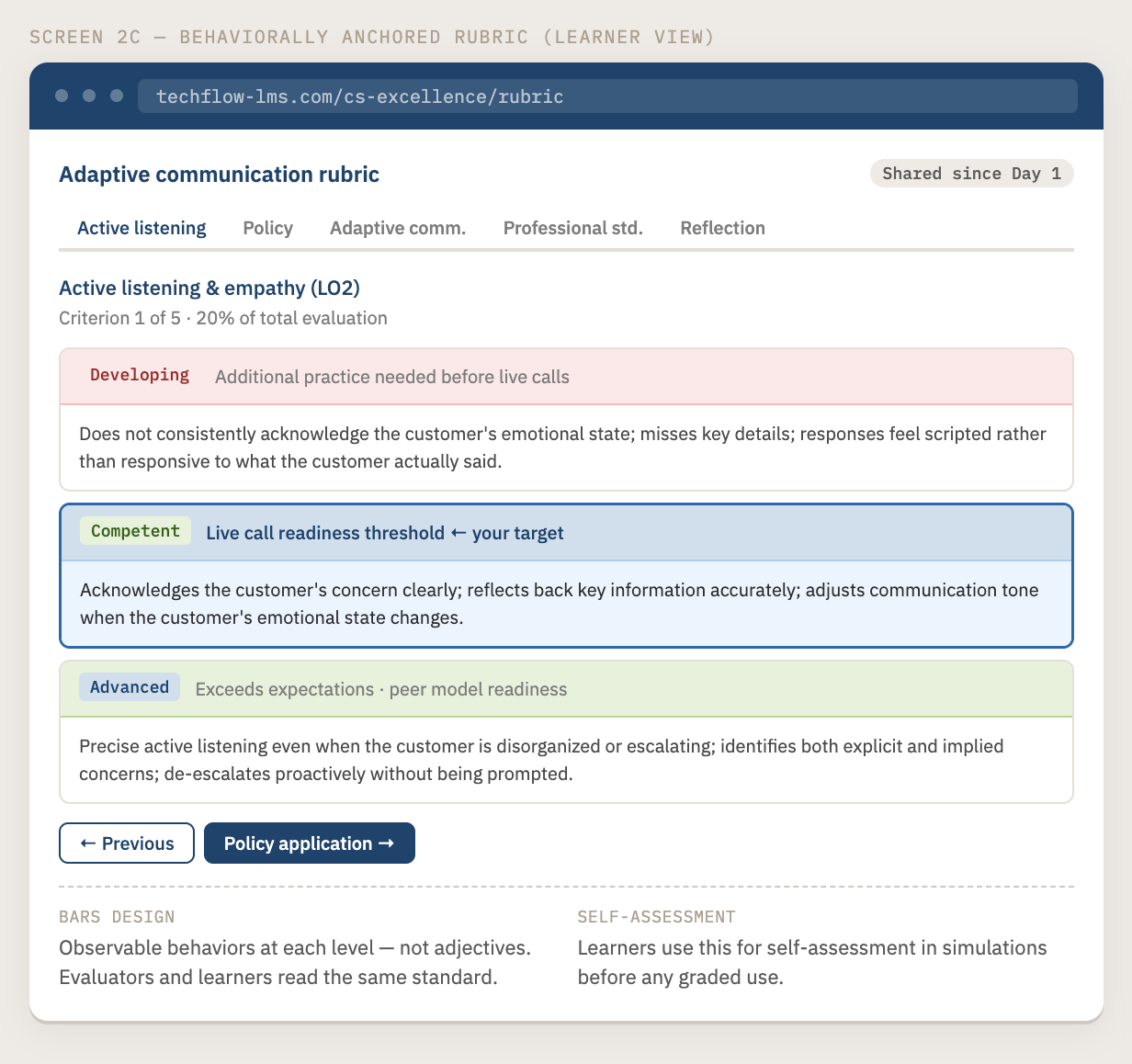
![UI wireframe showing the behaviorally anchored rubric from the learner's perspective]()
Behaviorally anchored rubric (learner view)
-
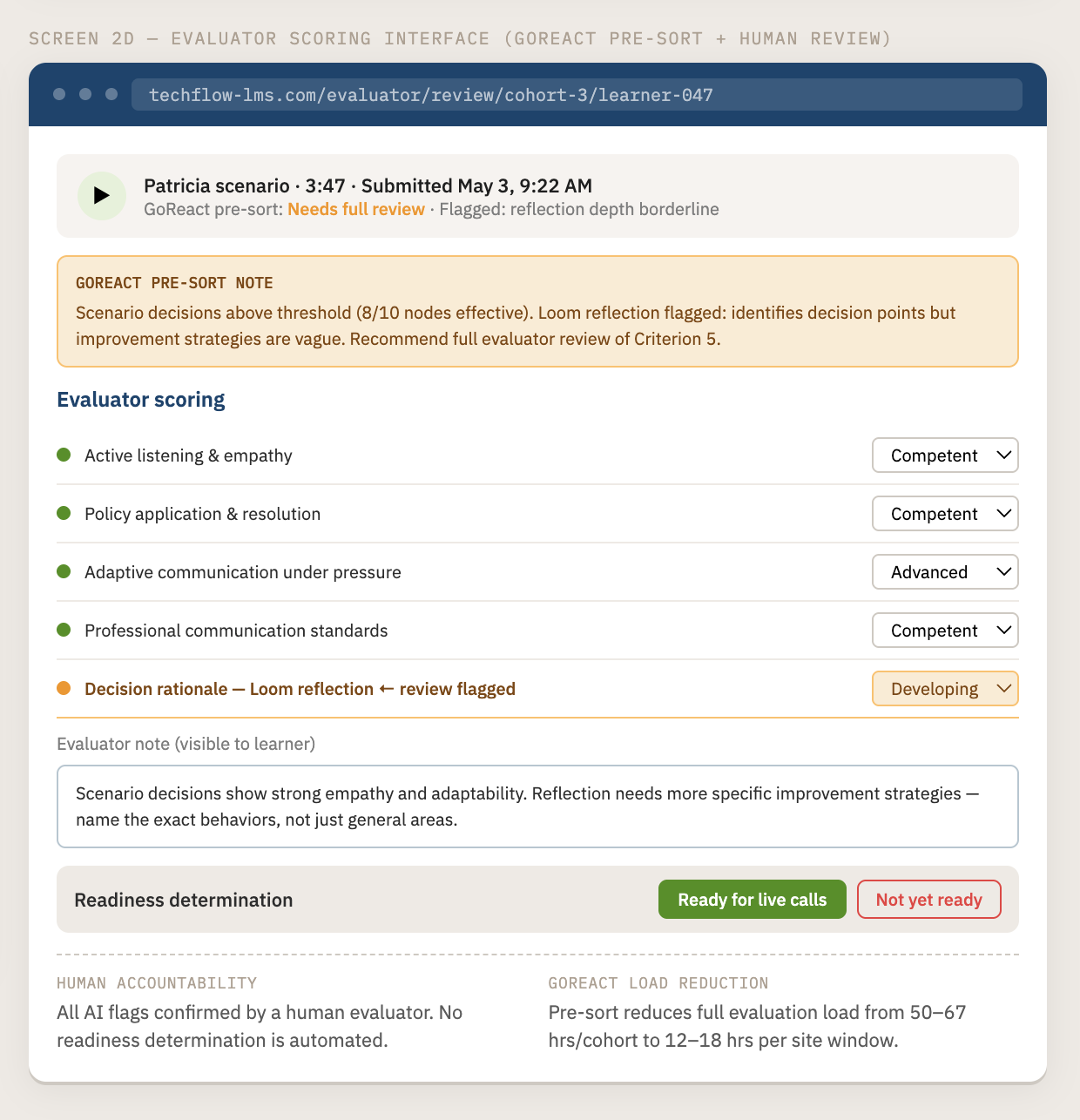
![UI wireframe showing the evaluator scoring interface with GoReact AI pre-sort and human review]()
Evaluator scoring interface (GoReact pre-sort + human review)
-
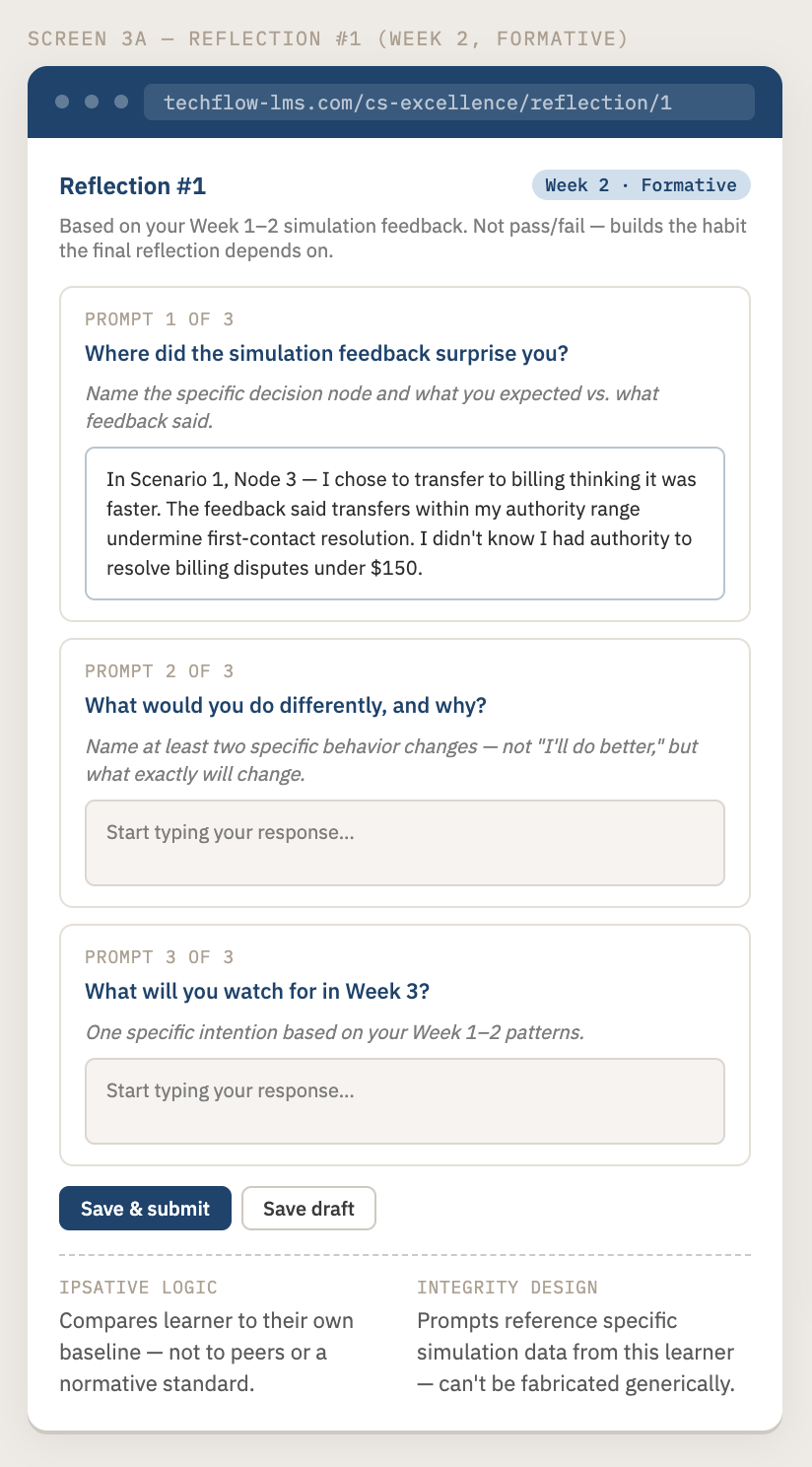
![UI wireframe showing Reflection 1 — a formative reflection prompt from Week 2]()
Reflection #1 (Week 2, formative)
-
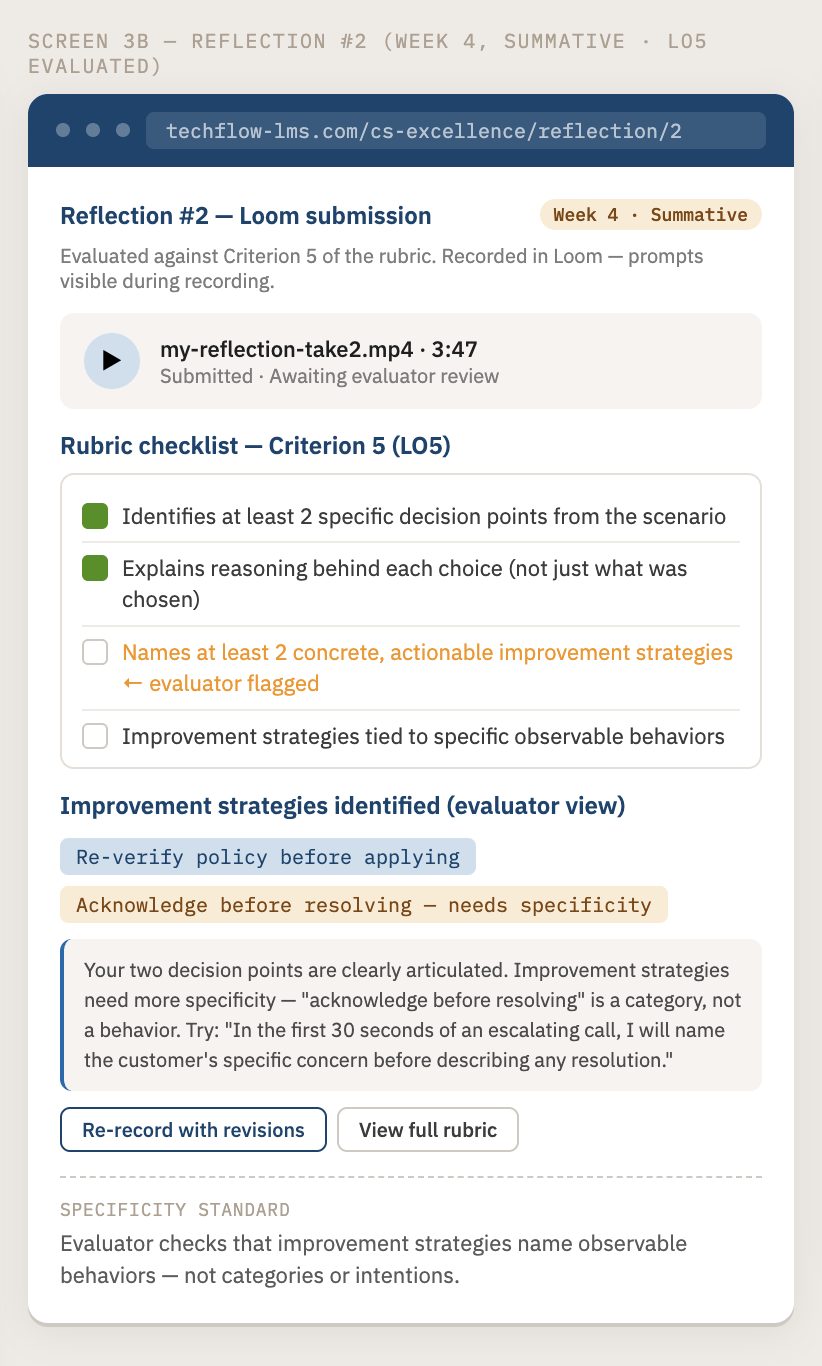
![UI wireframe showing Reflection 2 — a summative reflection prompt from Week 4 evaluating Learning Objective 5]()
Reflection #2 (Week 4, summative · LO5 evaluated)
-
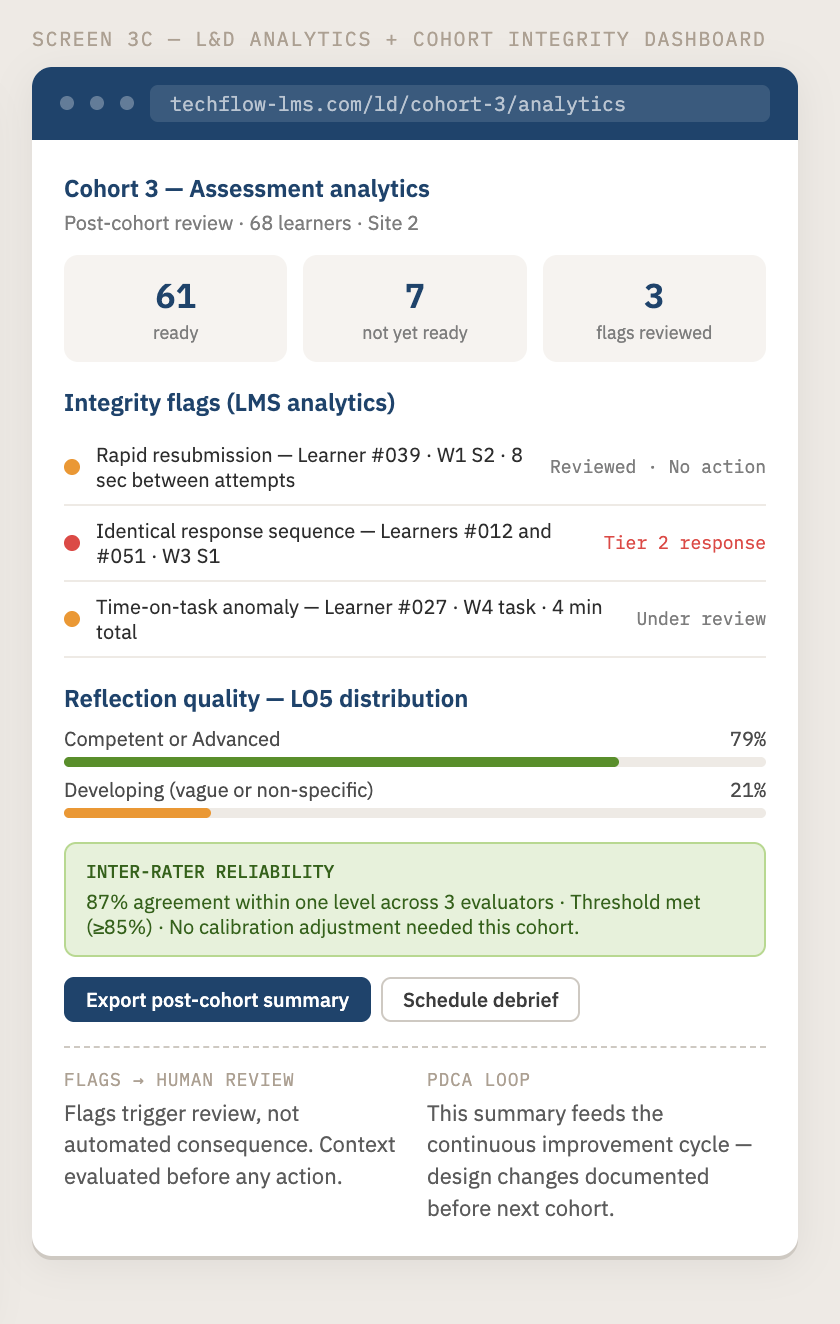
![UI wireframe showing the L&D analytics and cohort integrity dashboard]()
L&D analytics + cohort integrity dashboard
Outcomes & Reflection
The project received glowing feedback — confirmation that the work crossed the line from exercise into something that actually demonstrates professional capability. This is the piece in my portfolio that shows I can apply instructional design methodologies at a systems level, not just component by component.