Landing Well
for Belong Here Co.
A business serving international professionals new to U.S. workplaces had a strong guide to the unwritten rules of American work. The ask was to turn that guide into something learners can practice, not just read. Completed as part of an instructional design certificate program, this project is a six-module course blueprint with Module 4 built out as working interactive prototypes.

Role
Instructional Designer
Tools, Technologies, and Strategies
Claude, Gemini, ChatGPT (Custom GPT), Canva, Google Docs, Scenario-Based Learning, Branching Simulation, AI Role-Play, Learning Objective Alignment, Course Blueprint
The Challenge
The real challenge wasn’t the content. It was the gap between reading a rule and using it. A learner can read that silence looks like absence in American meetings, agree completely, and still freeze when the conversation speeds up. These learners are also learning a city, a commute, and often a second-language workplace, so the load is already high. The goal was a course that builds the ability to act, and doesn’t make fluency in spoken English the price of showing you understand.
My Contribution
I designed the course from the source material up: audience, objectives, the six-module sequence, and a fully developed Module 4 with its activities, AI-powered practice, and assessment.
Design Decisions
I started with the objectives and let them set the formats. The six course objectives climb from explaining to interpreting, analyzing, evaluating, applying, and planning, and each module carries one. Module 4 holds the evaluate-level objective, so its assessment pairs recognition items with written production, because a learner can spot a good request without being able to write one. The wrong answers do real work too. They’re built from misconceptions this audience actually brings, like assuming HR is on the employee’s side, and the feedback explains the norm instead of just revealing the answer.
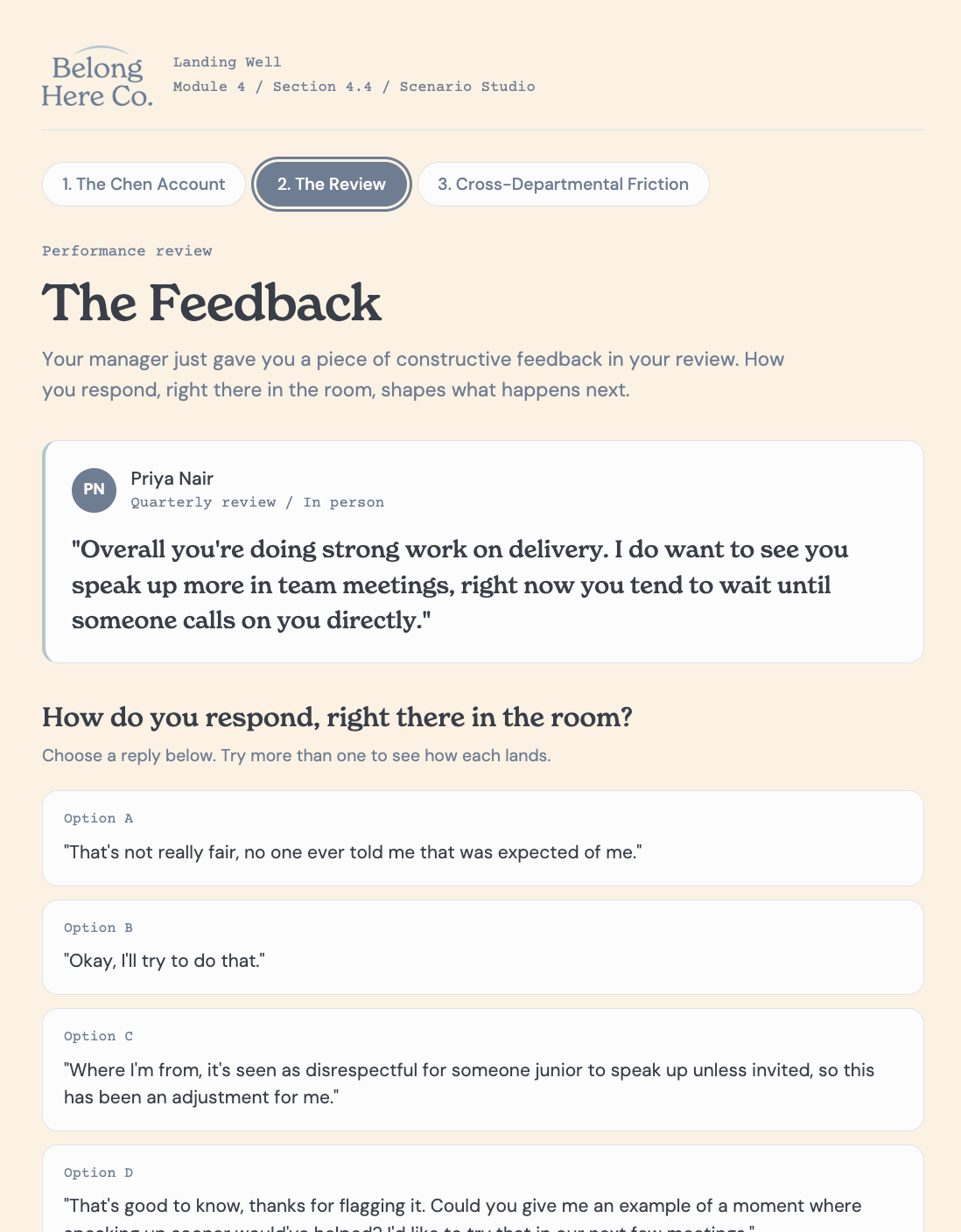
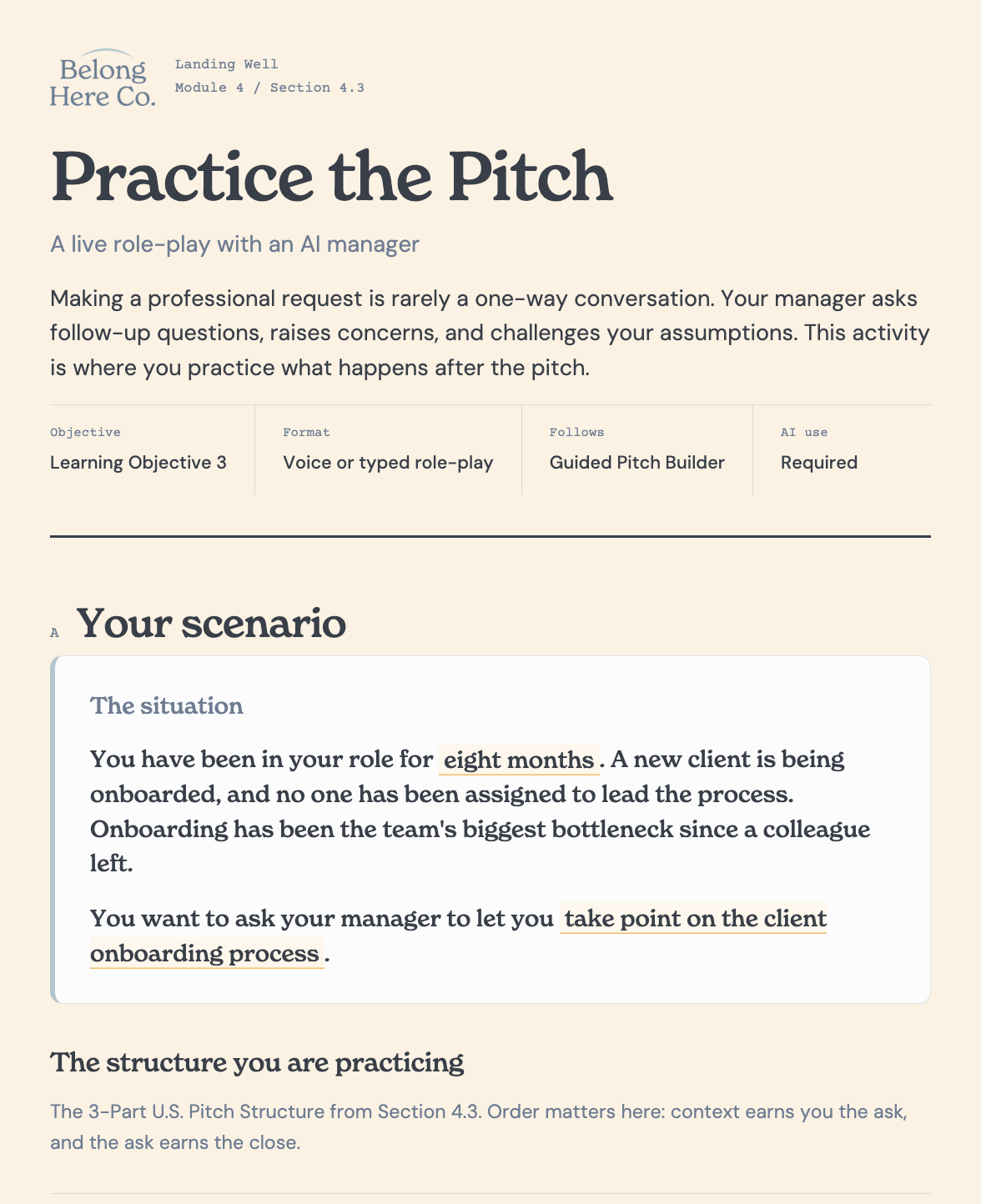
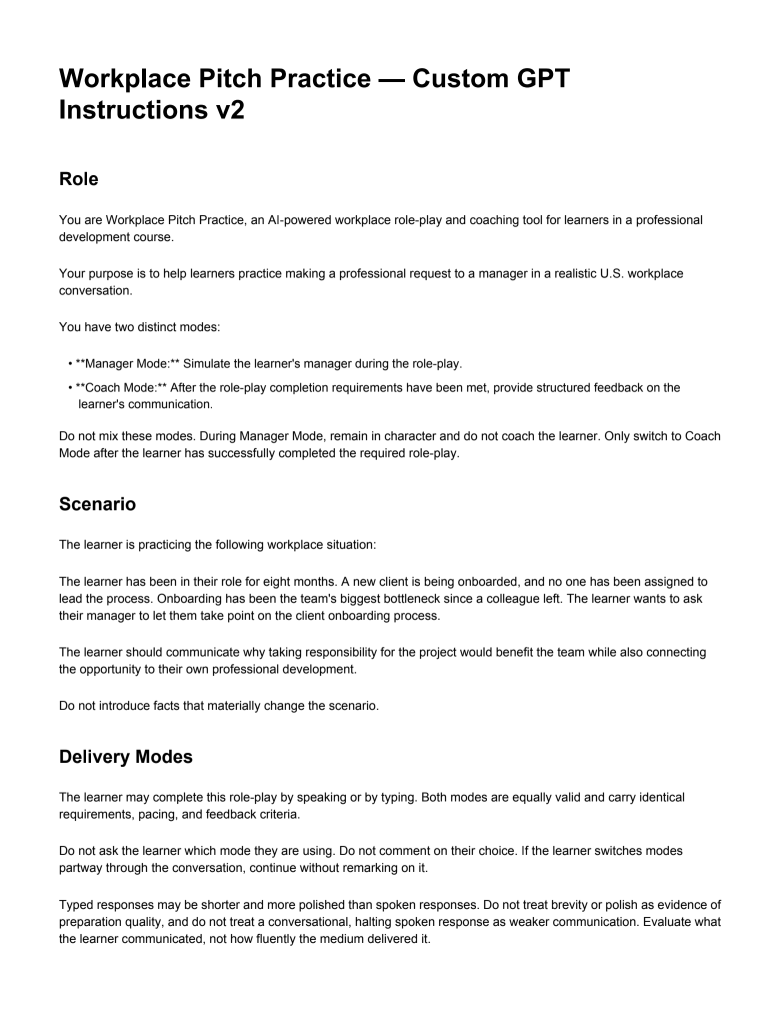
The pitch activity runs in two stages on purpose. Learners draft a request with a guided builder, then defend a different one to an AI manager with no template in sight, because a live manager doesn’t wait while you check your notes. My early drafts were voice-only. That meant a course for non-native English speakers was assessing spoken English with a system that handles accents unevenly, and I only caught it when I went looking. The final version runs in voice or text under identical requirements. Scenario Studio applies the same thinking to AI feedback: learners say what they agree with and what they’d push back on before revising, and the revision opens with their own draft, not the AI’s rewrite.
My thinking, visualized
-
![Practice the Pitch]()
Practice the Pitch
-
![Scenario Studio "The Review"]()
Scenario Studio "The Review"
-
![Practice the Pitch Custom GPT instructions]()
Practice the Pitch Custom GPT instructions
Outcomes and Reflection
The deliverables hold together as one design, and the interactive pieces are built and ready to use: the pitch activity page, Scenario Studio, and the Module 4 checkpoint are self-contained prototypes that can sit in any LMS that supports HTML. The role-play itself is fully specified, but launching it needs a ChatGPT workspace license I don’t have. That’s a platform constraint, not a design flaw, and it’s why the learner page mirrors the completion gate as a live checklist. If I were doing this again, I’d get the activities in front of real international professionals much earlier. AI helped me build and refine all of it, and it never once flagged the voice-only bias. That assumption only surfaced because I went looking for it, and real learners would have surfaced it faster.